Key Features to Review When Buying Land in Washington County
March 24, 2026
March 24, 2026
Thinking about buying land in Washington County? The right tract can set you up for years of good living, but the wrong one can bring surprise costs and headaches. You want clear access, reliable water, workable soils, and straightforward permitting. In this guide, you’ll learn how to evaluate the most important land features with local steps, documents to request, and where to verify details before you make an offer. Let’s dive in.
Legal access is the first gate. Confirm that the deed or plat shows recorded ingress and egress to a public road. If access crosses a neighbor’s property, ask for the recorded easement language. You or your title company can locate these in the County Clerk’s deed and plat records. You can start with the county’s records portal at the Washington County Clerk.
What to request:
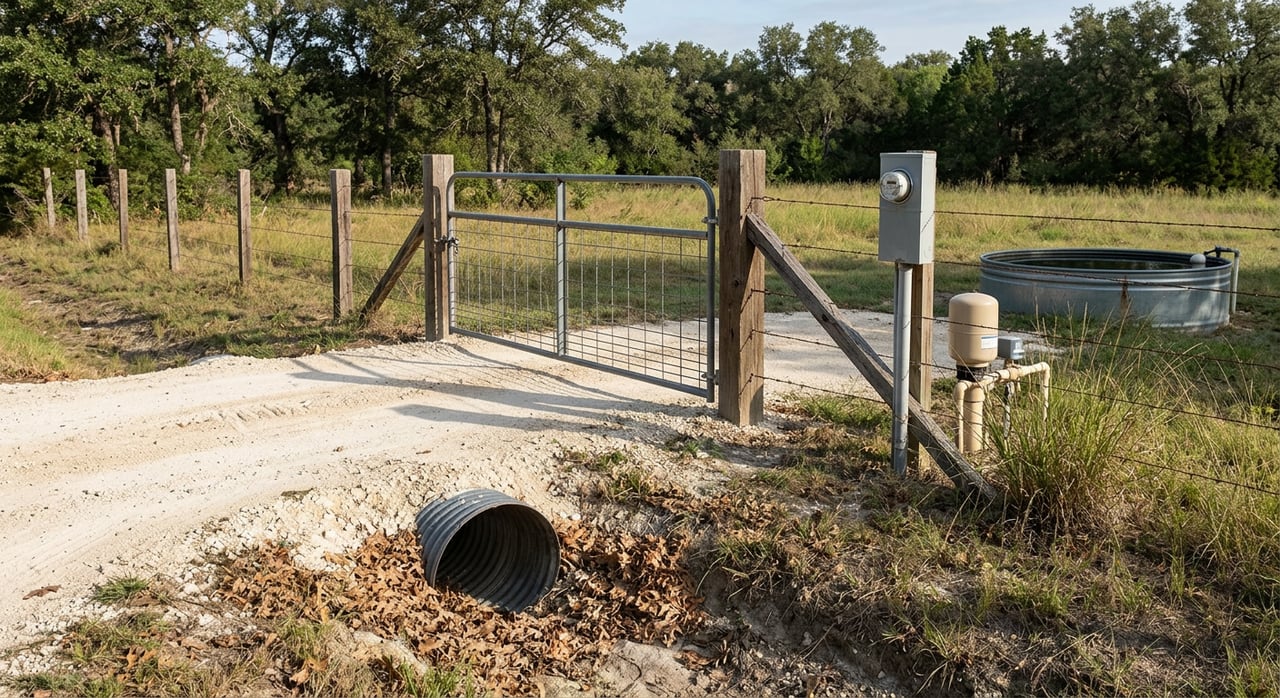
Is the road public or private? Washington County maintains a county road system and requires a culvert or driveway permit when you add an entrance to a county road. You can review permit info with Washington County Engineering & Development Services. If the road is private, ask for the maintenance agreement or HOA/POA rules. If none exist, clarify who pays to maintain the road.
What to request:
In Washington County, your 911 address is based on the driveway location. If there is no driveway, the county will wait to assign an address until one is marked. Plan ahead with the County Addressing office so utilities, deliveries, and emergency services find you without delay.
Much of the county is served by Bluebonnet Electric Cooperative. If power is not at the property line, ask for a service availability letter and a line extension estimate, which can affect budget and timeline. Start with Bluebonnet Electric Cooperative.
What to request:
Inside city limits or a water service area, you may have access to municipal water. The City of Brenham operates water and wastewater utilities, and it publishes service and contact details for tap fee questions. Check the City of Brenham Public Utilities page for context and next steps.
If you will rely on a private well, ask for the well log (driller’s report), a recent pump test, and a basic water quality lab report. You can compare local depth and yield patterns with the TWDB Groundwater Database, and you can ask a local driller what they see in the immediate area.
What to request:
Brenham also operates a municipal gas system in its service area. Outside municipal service, many rural tracts use LP tanks. Confirm availability, tap fees, or tank requirements with the provider. You can find system contacts on the City of Brenham utilities page.
Coverage varies by address. Ask the seller which provider they use, then confirm directly with local ISPs. If terrestrial service is limited, explore satellite options. Always verify service at the exact driveway location once assigned.
Well performance drives day-to-day usability on rural land. Review the well log for construction details, static water level, and tested yield. If the tract has no well, get a driller’s estimate for expected depth and productivity in that spot. The TWDB Groundwater Database hosts public well reports that help you compare nearby results.
Small private ponds often qualify for the Texas stock tank exemption for domestic and livestock uses. Larger dams, impoundments on defined watercourses, or work affecting wetlands may trigger state or federal permits. For a plain‑English primer on when permits may apply, review Texas A&M AgriLife’s guide, A Pond to Call My Own. If in doubt, get a site review before you move dirt.
Washington County administers on‑site sewage facilities, often called septic systems. All new, altered, repaired, or enlarged systems require a county permit before work begins, plus a soil and site evaluation. You can confirm requirements and find permit packets with Washington County Environmental Health.
If the property includes an existing system, request the original permit, maintenance records, and any recent inspection reports. Aerobic systems must have a maintenance contract and registration per county rules. For raw tracts, budget for a permitted design and note separation distances to wells and water bodies.
What to request:
Washington County participates in the National Flood Insurance Program and requires a county floodplain determination and permit before development inside mapped flood areas. Start with the county’s mapping references and permit details on the Environmental Health floodplain page. If the tract sits in the floodplain, ask for any elevation certificate and prior floodplain permits. Plan site layout, pad elevation, and culvert sizing with this in mind.
What to request:
Washington County sits in a region where clayey soils are common. That matters for septic design, pond sealing, driveway performance, and foundation behavior. On smaller projects, a soil evaluation may be enough. For larger builds, consider a geotechnical report to test bearing capacity and shrink‑swell potential. Good data up front helps you budget for lime stabilization, select septic type, and pick the best building site.
What to request:
Order an up‑to‑date survey to verify acreage, corners, and encroachments. Fences are not always on the line, so walk the fence with the survey in hand. If you plan improvements or financing, consider an ALTA/NSPS survey to capture easements and improvements in one product. Ask the title company to show recorded easements and rights‑of‑way in your title commitment.
In Texas, mineral estates are often severed. Ask the title company to identify mineral reservations and any active or historic oil and gas leases. Clarify whether surface operations or rights‑of‑way could occur on the tract, then plan building sites and access accordingly.
What to request:
If you will run livestock or your neighbor does, verify fence type and location relative to the boundary. Clarify who maintains each fence segment and whether any cost‑sharing agreements exist. Washington County also posts local estray notices that show how livestock issues are handled. You can view the county’s process at Estray Notices.
Washington County has a hands‑on framework for roads, septic, and floodplain management. The county manages a large network of county roads and requires permits for entrances that connect to county‑maintained roads. You can confirm what is needed with Engineering & Development Services. The same office’s Environmental Health division handles OSSF permitting and floodplain determinations, with details on the Environmental Health page.
One more local note: the county states that in unincorporated areas no building or electrical permits are required. That does not remove requirements for floodplain work, septic permits, driveway or culvert permits, and subdivision review. Always verify your specific plan with the county before you start work.
If you see any of these, get documentation. Ask for provider letters, a title opinion, and engineer estimates. Order a boundary or ALTA survey, a septic feasibility and soil test, and a pump test with lab analysis for water quality.
Land in Washington County can be a great fit for a country home, weekend place, or a working setup. When you ground your search in access, utilities, water, septic, floodplain, soils, and fencing, you protect your budget and your timeline. If you want a second set of eyes on a tract or need help lining up the right inspectors and providers, I’m here to help. Connect with Caitlin Jacob to start a focused, step‑by‑step land search.
Stay up to date on the latest real estate trends.
Whether you’re buying your first home or selling a property, Caitlin Jacob delivers attentive service and market insight to help you achieve your real estate goals in South Central Texas and surrounding areas.